Wednesday, 13 January 2016

Time to end the bad blood between the Yorubas and Ndigbo


Vanguard News - Latest updates from Nigeria, including business, politics, entertainment, fashion, health, technology, naija lifestyle


By Femi Aribisala
THE Yorubas and the Igbos, two of the most resourceful, engaging and outgoing ethnic groups in Nigeria, are becoming implacable enemies. Increasingly, they seem to hate one another with pure hatred. I never appreciated the extent of their animosity until the social media came of age in Nigeria. Now, hardly a day passes that you will not find Yorubas and Igbos exchanging hateful words on internet blogs.
The Nigerian civil war ended in 1970. Nevertheless, it continues to rage today on social media mostly by people who were not even alive during the civil war. In blog after blog, the Yorubas and the Igbos go out of their way to abuse one another for the most inconsequential of reasons. This hatred is becoming so deep-seated, it needs to be addressed before it gets completely out of hand. It is time to call a truce. A conscious effort needs to be made by opinion-leaders on both sides of the ethnic divide to put a stop to this nonsense.
Ethnic stereotyping
Both the Yorubas and the Igbo stereotype one another. To the Igbo, the Yorubas are the “ngbati ngbati” “ofemmanu” who eat too much oil. They are masters of duplicity and deception; saying one thing while meaning another. To the Yorubas, the Igbo are clannish and money-minded. They are Shylock traders who specialise in selling counterfeit goods.
But the truth is that stereotypes are essentially generalisations and exaggerations. In a lot of cases, they are unreliable and untrue. Stereotypes must be recognised at their most effective as a joke. They are the stock-in-trade of seasoned comedians; the garnish for side-splitting anecdotes at weddings and social gatherings. Stereotypes should not be taken seriously. We should laugh at them without being offended by them.
The more Nigeria develops as a melting pot of nations, the more we should be able to laugh at ourselves. The greater inclination to do this denotes increasing strength of character and self-confidence. However, with the advancement of social media, the banter has gone way beyond the jocular and innocuous to outright malice and unadulterated hatred. Increasingly, what you hear are abusive and pejorative labels of “Yariba,” “Yorubastards” and “Yorobbers;” as well as “Eboes,” “Zooafrans” and “Biafrauds.”
As the insults fly with abandon, you begin to wonder where all this comes from. What is the basis of all this hate? In the sixties, the Igbo were slaughtered in pogroms in the North. However, the principal exchange of hateful words today is not between Northerners and Easterners, but between Easterners and Westerners. Why are these two ethnic groups so much at loggerheads? How did we get to this pass?
Malicious stereotyping often involves denigrating the strengths of others. The Igbo are very enterprising; a very valuable resource in a developing country like Nigeria. But then this is castigated as mercenary. The Yorubas take great pride in education; another valuable asset in today’s modern world. But then they are derided as using this to get one over on others.
The saving grace is that the two groups live side-by-side in peace and quiet in different parts of the country. Moreover, the animosity between them, especially among the younger generation, has not prevented their boys and girls and men and women from falling in love. Yoruba men marry Igbo women; and Igbo men marry Yoruba women. Meanwhile, “a lutta continua.”
Awolowo factor
The Igbo tar the Yorubas with the brush of Awolowo, who they label as “the father of ethnicity in Nigeria.” In that narrative, it is conveniently overlooked that the broadmindedness of the Yorubas enabled Azikiwe, an Igbo man, to win a regional election in the Yoruba heartland in 1954. Instead, what is harped on is the fact that Awolowo mobilised Yoruba politicians to nullify that victory by decamping from Azikiwe’s more nationalist camp to Awolowo’s more ethnically-focused camp.
One of the newspaper headlines that sticks in my memory from 50 years ago is the one that said: “If East Goes, West will Go- Awo.” After a visit to Ojukwu in Enugu at the height of the acrimony over the mass killing of the Igbo in the North in the mid-1960s, Awolowo declared that if the East was allowed to secede as a result of acts of omission or commission, he would also lead the West into secession.
This flashed a green light for Igbo secession. But when the East seceded, Awolowo failed to mobilise the West to follow suit. Not only did the West not join the East in secession, it joined the North in fighting against the East. Awolowo then became the Commissioner of Finance and Vice-President of the Federal Executive Council of the Nigerian government that prosecuted the war against Biafran secession.
The Igbo have rightly deemed this a great betrayal. But their case against Awolowo did not end there. As finance minister, Awolowo was the brainchild of the strategy to blockade Biafra; leading to mass Igbo starvation and deaths. With the end of the war, it was also alleged that Awolowo orchestrated the policy whereby the totality of individual holdings of Biafran currency was converted to Nigerian legal tender at a flat maximum amount of only 20 pounds.
This effectively pauperized the Igbo. Since it also coincided with the period when Nigerian corporations were being privatised, it had the effect of locking out the Igbo from strategic sectors of the Nigerian economy; gobbled up in the main by the Hausa-Fulanis and Yorubas.
Brothers in adversity
The Igbo case against Awolowo has become the Igbo case against the Yorubas. In the process, it is easily overlooked that prominent Yorubas, like Tai Solarin and Wole Soyinka, defended the Igbo right to self-determination during the Biafran War. The properties the Igbo left behind in Yorubaland during the Civil War were not expropriated by the Yorubas, as they were in some other places. When Odumegwu Ojukwu came back from exile in Ivory Coast, all his father’s properties in Lagos remained intact.
Under President Obasanjo, a Yoruba man, the Igbos were given the control of Nigeria’s economic and monetary policy. The Minister of Finance, Ngozi Okonjo-Iweala; Governor of the Central Bank, Charles Soludo; and Director-General of the Stock Exchange, Ndidi Okereke-Onyuike, were all Igbos. So were the Minister of Education, Obiageli Ezekwesili; and the Director-General of NAFDAC, Dora Akinyuli.
Indeed, Obasanjo favoured the Igbo more than his native Yorubas. He appointed an Igbo, Thomas Aguiyi-Ironsi, as the Minister of Defense and another, Air Marshal Paul Dike, as Nigeria’s first Igbo Chief of Air Staff. While the Igbo visit the transgressions of Awolowo on the Yorubas, they do not visit the favouritism of Obasanjo on the Yorubas.
The sins of Awolowo were brought again to the fore in 2012 by Chinua Achebe in his book: “There Was a Country: A Personal History of Biafra.” The blogs came alive as blame was traded on both sides of the East-West divide. Awolowo was now cast by the Igbos as the father of the Yorubas; and they were determined to visit his sins on his Yoruba sons to the third and fourth generations.
Mistakes galore
Blunders continue to be made on both sides, fanning the flames of hatred. Governor Babatunde Fashola of Lagos State blundered by deporting some destitute Igbos back to the East in the dead of night in 2013. This created uproar in the sizeable Igbo community in Lagos. Even though Fashola expressly apologised to Ndigbo for the faux pas, a ridiculous discussion nevertheless ensued about the rightful ownership of Lagos.
Orji Uzor Kalu, former governor of Abia State, put his foot in it when he declared that Lagos, as a former national capital, was “no man’s land and so belongs to all of us.” This incensed ethnic jingoists in Yorubaland who, forgetting the traditional hospitality of the Yorubas, asked the Igbo to leave Lagos and go back East.
But nothing quite compares to the broadside that came from the Oba of Lagos. During the 2015 election, Oba Rilwan Akiolu summoned Lagos Igbo leaders to his palace; only to threaten them: “If anyone of you, I swear in the name of God, goes against my wish that Ambode will be the next governor of Lagos state, the person is going to die inside this water. What you people cannot do in Onitsha, Aba or anywhere you cannot do it here. If you do what I want, Lagos will continue to be prosperous for you, if you go against my wish, you will perish in the water.”
It mattered little to His Royal Highness that Ambode’s close rival was not an Igbo but Jimi Agbaje; another Yoruba man.
Timeout
The Yorubas and Ndigbo do themselves great disservice by seeing themselves as arch-enemies. Within the framework of Nigerian politics, this has limited the freedom of action of both ethnic groups. If one is prominent in this political party, the other is more likely to align itself with another party. This means the one can always be manipulated against the other. Instead, the political space should be opened up by the possibility that the Yoruba and the Igbo can form an alliance. That eventuality is not implausible especially because they actually have common interests.
Both groups prefer a Nigeria that practices fiscal federalism. Both want a country with a weaker centre. Both want a Nigeria that rewards merit, with a state-structure based on resource-control. Both groups want a Nigeria committed to self-determination. These are grounds for cooperation as opposed to discord. If the North is not to continue to take the South for granted, it must not be allowed to continue to operate in the confidence that the East and the West will always be divided.
In politics, there are no permanent enemies and no permanent allies. Fifty years down the road, the politics of the Nigerian Civil War should not be allowed to continue to cast a shadow over Yoruba-Ndigbo relations. In the Second World War, Germany was the arch-enemy of France, but now both countries are the staunchest allies. Japan invaded the United States; but now both are on the same side. These turnarounds can and should be duplicated in Southern Nigeria.
As a first step, there is need for a grand gesture. A well-publicised meeting between the Afenifere and the Ohaneze, where declaratory statements should be made about burying the hatchet. Thereafter, standing committees should be established to deal with flashpoints; such as the dismantling of Oshodi market in Lagos. The hatred between the Yoruba and Ndigbo has gone on for far too long. Let there be love shared among us!

Monday, 11 January 2016

Arms probe: SERAP sends an open letter to Jonathan

Vanguard News - Latest updates from Nigeria, including business, politics, entertainment, fashion, health, technology, naija lifestyle

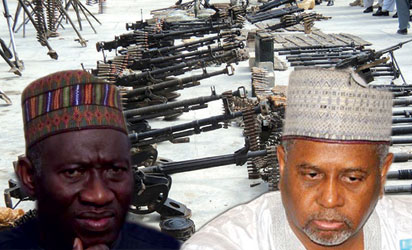
LAGOS— Socio-Economic Rights and Accountability Project, SERAP, has sent an open letter to former President Goodluck Jonathan seeking explanations from him on what he knew on the diversion and sharing of over $2 billion meant for purchase of arms to fight Boko Haram.
Dasuki-Sambo-jonathanSERAP’s Executive Director, Mr Adetokunbo Mumuni, in a letter, which read in part, said: “SERAP is sending you this open letter to seek explanations from you, as former President and Commander-in-Chief of the Nigerian Armed Forces, on what you knew, or had reason to know on the apparent diversion and sharing of the over $2 billion meant to purchase arms to empower Nigerian soldiers to fight Boko Haram.
“SERAP considers that there is enough material in the public domain to suggest that over $2 billion meant for purchase of arms to equip Nigerians soldiers fighting Boko Haram in the North East of the country was diverted and shared among high-ranking government and party officials under your watch as President and Commander-in-Chief of Nigerian Armed Forces.
“SERAP and indeed Nigerians reserve the right to pursue justice through appropriate national and international accountability mechanisms to ensure that everyone involved in this heinous crime is brought to justice in accordance with international standards of fairness.
“Is it correct to suggest that the budget of over $2 billion to purchase arms for Nigerian soldiers fighting Boko Haram in the North-East of the country was authorised by you or your office? In other words, did your former National Security Adviser (NSA), Col. Sambo Dasuki (retd) seek your approval to collect from the Central Bank of Nigeria the over $2 billion meant for purchase of arms for Nigerian soldiers?
“If so, Nigerians would like to hear from you whether the apparent diversion and sharing of our commonwealth by your former NSA was expressly or implicitly authorised by you.
“Is it then correct to suggest that the former NSA implements presidential decisions and not make them? If so, is it also correct to suggest that the apparent diversion and sharing of the over $2 billion meant for purchase of arms was a presidential-level decision and that you signed off on it?
“Is it not correct to suggest that your administration acted on the basis that it was essentially unrestrained by international or Nigerian law in engaging in or encouraging the apparent diversion and sharing of the over $2 billion meant to purchase arms for Nigerian soldiers in order to protect them against attacks from Boko Haram and to enhance their ability to defend the territorial integrity of the country and provide security for its citizens?”
“Assuming you did not directly order or authorise the apparent diversion and sharing of the over $2 billion meant to purchase arms for Nigerian soldiers, is it fair to suggest that you at least knew, or had reason to know, that your own former NSA was apparently involved in the heinous crime of corruption to wit: the diversion and sharing of over $2 billion meant to purchase arms for Nigerian soldiers; and did not take all necessary and reasonable measures in your power as Commander-in-Chief and President to prevent the alleged diversion and sharing of our commonwealth, as explained above?
“Would you accept that the apparent diversion and sharing of the over $2 billion was largely due to your failure to ensure: (1) that system was in place to ensure a transparent and accountable spending of budget for military operations in strict accordance with the standards of international law including the UN Convention against Corruption; (2) that any such system was operating in a continuous and effective manner; and (3) that violations of the standards were punished when detected by that system?
“After the apparent diversion and sharing of the over $2 billion was brought to your attention, did you take any step to refer your former NSA and all those involved in the diversion and sharing to appropriate anticorruption agencies to ensure that all those who were alleged to be responsible for this heinous crime of corruption are brought to justice?
“Would you agree that the apparent diversion and sharing of the over $2 billion meant for purchase of arms for Nigerian soldiers has seriously undermined the ability of the soldiers to defend themselves and fight Boko Haram; resulted in some soldiers being unfairly tried for refusing to fight without being provided with necessary arms; inflicted severe pain or suffering; and caused unnecessary loss of lives and displacement of law-abiding citizens?
“Would SERAP be correct to suggest that you, as President and Commander-in-Chief, knew about the authorization, apparent diversion and sharing of the over $2 billion meant to purchase arms for Nigerian soldiers, in the chain of command involving your former NSA and others?
“Would it therefore be correct to further suggest that your acts and/or omissions concerning the apparent diversion and sharing of the over $ 2 billion were such as to give rise to personal liability through command responsibility for the actions of your former NSA and others who worked under you?
“Would you now, on the basis of the above, apologise to Nigerians for the apparent diversion and sharing of the over $2 billion and the catastrophic consequences for Nigerian soldiers and their families, including those who have lost their lives; those unfairly tried and convicted; and millions of displaced Nigerians?
“Nigerians are eagerly awaiting your clarifications on the issues raised above, and your apology.”

Sharing of arms money: Public office seekers must be mentally examined — Bola Ajibola

Vanguard News - Latest updates from Nigeria, including business, politics, entertainment, fashion, health, technology, naija lifestyle

By Bashir Adefaka
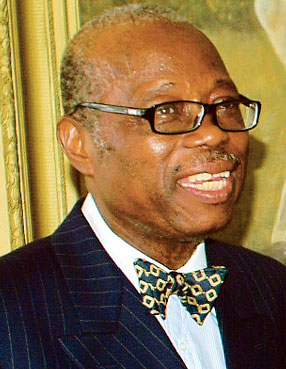
Prince Bola Ajibola (SAN),was president of the Nigeria Nigerian Bar Association (NBA) between 1984 and 1985 when he led Nigerian lawyers in a boycott of the courts in protest against the perceived dictatorial tendencies of the General Muhammadu Buhari military regime.
You will be judged by your performance and not by fighting corruption, Bola Ajibola tells Buhari
Bola Ajibola
Following the overthrow of the Buhari regime, Ajibola was appointed the Minister of Justice and Attorney General of the Federation, and notably served the nation gratis despite employing a number of enterprising lawyers as aides. One of the aides who served as his Senior Special Assistant was one Mr. Yemi Osibanjo, presently the Vice-President of the country.
Prince Ajibola subsequently rose to serve as a judge of the International Court of Justice at The Hague. Ajibola, 81, is the Olori Omo Olowu of Owu Kingdom, Abeokuta, Ogun State and is the proprietor, Crescent University Abeokuta, Ogun State. In this interview he encourages the government not to backtrack in the fight against corruption, advises his former ward, Prof. Osibanjo and laments how vice has hindered Nigeria’s growth. Excerpts:
What is your reaction to the ongoing anti-corruption battle of the Muhammadu Buhari administration?
Corruption is really sad and already endemic in our country.  It is a kind of cankerworm that has eaten deep into our fabrics.    It is an unfortunate act that has debarred many things that we could have done to make progress. It is terribly retarding our progress.    It is very unfortunate that with corruption we are persistently regularly retrogressive. Otherwise, we would have been one of the best nations in the world.
Deep rooted corruption
We have quite a lot of intelligent and resourceful people in our country. We have people who are ready and willing to work to earn and take their integrity there. But unfortunately on the level of politics, a lot of things have gone wrong and it is sad that the situation is not encouraging.
Hopefully this new government will correct a lot of those bad situations that we have, because the name of Nigeria stinks to the outside world.    Nobody is really interested in dealing with anything from Nigeria because of the problem of this deep rooted corruption that is still raging among our people.
The new government that we now have is all out to do its best to rid our country of corruption but the situation is very heavy and it is very serious.    When you have so many people bent on dipping their hands corruptly into the purse of the government from all spheres of life in Nigeria, we still have a long way to go.
I have listened to a lot of hues and cries about the fact that the government is slow.    How could government not be slow under the present circumstance?    Because the government has a lot of hurdles to overcome in dealing with any problem.
In the midst of it all, unnecessary criticisms are always there and the people are just willing to criticise and not help develop the country.    We only hope that the present government would do its best to ensure that at this time, everything could be done to get rid of corruption in this country.
Do you think that the judiciary is really an obstacle in the administration’s anti-corruption campaign given the issuance of allegedly frivolous injunctions by judges?
The situation is a very sad one as I have said and it is deeply rooted.    And I mean deeply rooted in the past government and the past politicians.
A good example is this, there are so many politicians that EFCC and ICPC accused of corruption and they are all in court at the moment.    How many of them have we concluded?    How many of them have we convicted? How many of them are in prison? We are only informed about the fact that some have been accused and they have been granted bail and that is the end of it all. The whole thing is being treated with levity. There is the need for a serious action to be taken against these matters of corruption without which the whole thing will go on endlessly and they now consider it to be usual practice rather than for them to desist from this act of corruption.
And it is unfortunate because it is really downgrading our nation.    It is really destroying our nation and a lot of the countries all over the world found that we are seriously and hopelessly enmeshed in corruption and that practice is continuing unabated.    I only hope that this new government of Buhari would take it up seriously and deal with it.
Issue of Dasuki’s $2.1bn
Everybody is now watching the issue of Dasuki’s $2.1 billion and I hope he (the President) will, with that, send out the strong signal against those who are destroying the country.
When you look at the situation in the country and what is needed to develop the country, you will be sad to realise that we are so much put into our development box, that we are in need of power, that we are in need of roads, that there is need for security and safety of our people, that we need to develop our agriculture, that we need to develop our education and there are so many other things that we need to take care of.
Now, with all that we now have, this endemic, deteriorating situation about corruption, it is even a major assignment on its own that any government would face without facing any other problem at all. I must praise the efforts of those who are in government now because this is an attempt to change what looks unchangeable, what looks intractable.
Divisive tactics
It is sad and it is unfortunate but I hope and pray that they would be able to get hold of the problem and tackle everything about it.
Besides corruption, you had once called on President Buhari to also tackle infrastructure, security, education, health and power. Would you say the president is moving along the line of your suggestion?
Exactly!    He is looking that way, though slowly, but he is looking at it along that line to fight corruption and develop the country.    But it is extremely difficult to do both at the same time because divisive tactics and disturbances of these corrupt people continue to breed opposition against the government. They are not concerned about the very adverse approach now of the foreign countries against Nigeria.
But now that we have a government that is seriously looking into it, maybe with the assistance of the foreign governments, we would get somewhere and we would get their cooperation in order to develop further.    But it is a kind of herculean task for any government to single-handedly handle corruption and at the same time continue to develop the nation because, corruption is a backward cankerworm that will continue to destroy the creations, the development and the growth of the government too.

Arms and  ammunition

It will continue to do so. That is the sad aspect of it because corruption has its universal economic disadvantages not only locally, not only in states but the entire nation would suffer the effects. The whole nation will be soiled and deprived a lot of things.
The government will even not have enough to develop a lot of things that it ought to be doing.    How many times have we had the problem about ASUU strikes because they are not being well treated?    How many times have we suffered from the fact that we have not been able to deal with the issue of Boko Haram just because all the money earmarked for arms and ammunition were being stolen and taken away by some people?    We are suffering in the midst of it all.
What is your reaction to the spew of allegations about the sharing of money meant for purchase of arms by some few people?
That is the reason I have always felt that going into any public office, the aspirants must first of all be thoroughly examined, tested and their past performances and their positions must be looked into. In fact, they should also examine them mentally whether they are fit and proper persons to go into the offices.
They must also ensure that they are not going to fix in all those greedy people who are desirous of going in there to steal and to take the money of the government for their own purpose just to enrich themselves.
A lot of people think that going into politics is just getting there to steal what they can steal. There is this idea now of stomach infrastructure. So, is it government they are now going to serve with this idea of stomach infrastructure? That is very sad.    It is sad! When I was in government, I was there fully ready and conscious of my service to the nation and was interested in improving the position of the nation.    Not only had I refused taking my salaries but also I was pumping my money into it. I was serving with my money being put into it.    I was engaging the services of clerks, secretaries, staff into ministry of justice being paid for by myself.    Who is doing that now among them? All they are interested in is to get there and steal money to buy SUVs and to acquire as much as possible because they all think about governing as a place of booty where they can enrich themselves either by hook or crook and they are even the highest paid public servants in the whole world.

Highest paid public servants

It is terrible. We are behaving like backward people.
Vice-President Yemi Osinbajo worked as your Senior Special Assistant while you were Minister of Justice. Is there anything you would pass on to him to further the case for justice reform?
We did everything possible to engrave all those things there. It was our own time of law reform, law review and law projections and legislation with it. We did everything and I am sure that he will have enough materials that would help him at this time over there.    Because we were all there together, we worked together and we served day and night and, quite sincerely, we knew we were there to serve our nation and we were dedicated and devoted to that service with all our time, with all our resources, with all our intelligence and I hope that the vestiges of all those things will still be available for him to get things developed.
Can we have your view of the whole system?
You see when things are broken down terribly like this, you have to handle matter with care and with caution. The situation is a very serious one and because the foreign countries are now having it hard on us and they will intend to do so for sometime, things may become harder in the country.
Even as of now, lawlessness continues to rage seriously and heavily all over this country.    Now that the situation will become tougher and more serious, one will expect a lot of diabolical practices, a lot of terrible practices.    You, yourself must have heard of Arepo where people kept vandalising the pipeline and draining off the oil of the nation without any regard for those who ought to check and control them.
Lawlessness is raging all over the country now and this government must put serious effort to contain it. It is very, very important.
Diabolical practices
This is the time that security must be taken as part of the priority of the nation knowing full well that those who had been doing it in the past would like to continue doing it, knowing that when the situation is so hard they will become more lawless.
Therefore, it behoves the government to ensure that on the list of its priority is not only the corruption issue but also security of the nation and safety of the people. That is important because, without that, the situation could be worse because everybody is looking for means of defrauding the nation or grabbing anything from anybody.
You must have noticed the increase in kidnapping. They are not kidnapping small people again and that is another area where media should be careful because, if the media is involved in encouraging them by telling the public how much they intend to take, that is another serious matter.    Do you see what I mean?  So, we are in a serious situation.    We are in a dilemma and we must be very, very careful at this time to see what we can do to stop the menace.
And at this time the media should not be neutral.    They should key into the anti-corruption programme of the government by not allowing corrupt people use them to whip the kind of sentiment that will make them escape justice.