Thursday, 4 May 2017

Nigeria's ailing President Buhari misses third cabinet meeting


BBC

  • 3 May 2017
  •  
  • From the sectionAfrica
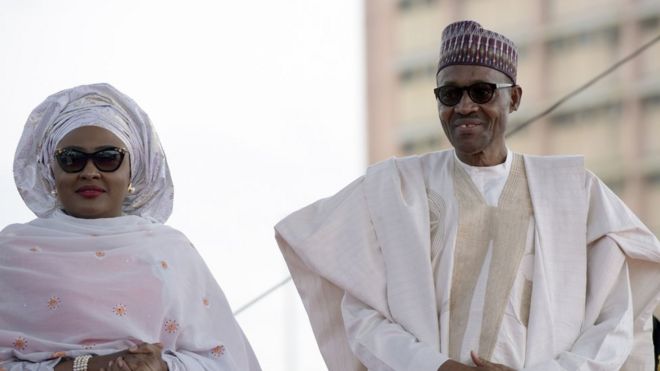
Aisha Buhari and Preseident Muhammadu Buhari at his inaugurationImage copyrightAFP
Image captionIn a series of tweets Aisha Buhari (left) tried to reassure Nigerians worried about the president's health
Nigeria's President Muhammadu Buhari has missed his third cabinet meeting in a row amid ongoing questions about the state of his health.
There are concerns about a leadership vacuum as one of Africa's largest economies struggles to pulls itself out of recession, correspondents say.
Information Minister Lai Mohammed said Mr Buhari "needed to rest".
In March, Mr Buhari returned from seven weeks of sick leave in the UK where he was treated for an undisclosed illness.
When he returned home he said he had never been so ill in his life.
To calm fears, the president's wife Aisha Buhari tweeted on Tuesday that her husband was not as sick as is being perceived.
But as he has not been seen in public for more than a week, Nigerians are continuing to discuss the issue.
In her tweets, Mrs Buhari said that the president was continuing to "carry out his responsibilities" and has been meeting with ministers.

Buhari's absence fuels speculation, Stephanie Hegarty, BBC Africa:
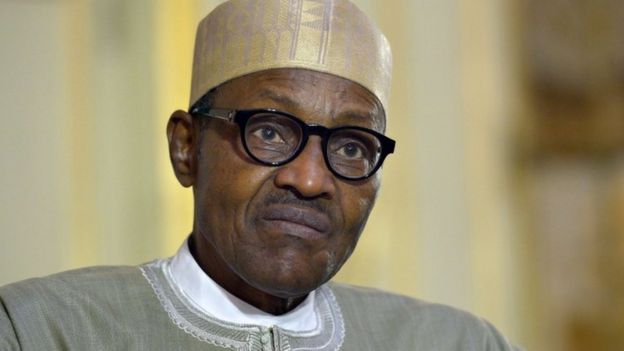
President Muhammadu BuhariImage copyrightAFP
Image captionPresident Muhammadu Buhari was in the UK for seven weeks for treatment
Mr Buhari has rarely been seen outside of his official residence in the eight weeks since he returned from the UK.
But the real controversy began when he stopped attending an important weekly cabinet meeting four weeks ago.
#WhereisBuhari started trending online and the writer Wole Soyinka, as well as prominent civil society activists, is calling on the president to release his medical records and to take official medical leave once again.
This is a crucial year for Nigeria and important decisions need to be made as the country struggles to get out of recession.
The presidency is keen to assure the public that Mr Buhari is still very much in charge because a power vacuum, or even the perception of it, could have very damaging effects.

Vice-President Yemi Osinbajo, who was the acting president while Mr Buhari was away in the UK, chaired the cabinet meeting in the capital, Abuja.
On Monday, a group of prominent Nigerians has called on Mr Buhari to take medical leave as concerns about his health grow.
They said in a statement that the president's absence from the cabinet meetings, as well as the weekly Friday Muslim prayers, "has fuelled further speculation and rumours" about his medical condition.
The 13 said they felt "compelled" to ask Mr Buhari "to heed the advice of his personal physicians by taking a rest to attend to his health without any further delay".
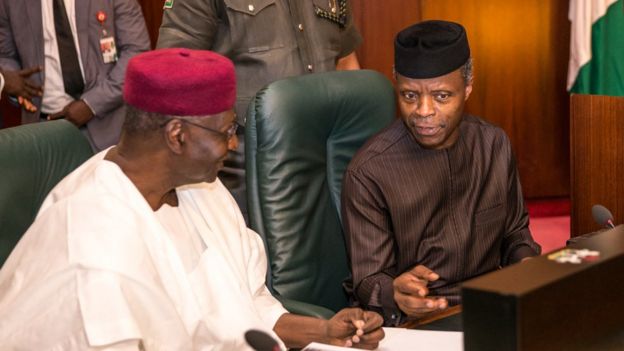
Vice President Yemi Osinbajo with Chief of Staff to the President, Mallam Abba KyariImage copyrightNOVO ISIORO
Image captionVice-President Yemi Osinbanjo (right) has stepped in to chair the cabinet meeting
Mr Buhari's personal assistant Bashir Ahmed said the president had met Justice Minister Abubakar Malami and other officials at the presidential villa on Tuesday as part of his official duties.
Last week, presidential spokesman Garba Shehu said Mr Buhari was "taking things slowly, as he fully recovers from the long period of treatment" in the UK.

Buhari's unhealthy start to 2017
19 January: Leaves for UK on "medical vacation"
5 February: Asks parliament to extend medical leave
10 March: Returns home but does not resume work immediately
26 April: Misses second cabinet meeting and is "working from home"
28 April: Misses Friday prayers
3 May: Misses third cabinet meeting
Related Topics

More on this story

Around the BBC

Aadhaar: Are a billion identities at risk on India's biometric database

BBC

  • 4 May 2017
  •  
  • From the sectionIndia

AadhaarImage copyrightMANSI THAPLIYAL
Image captionMore than a billion residents of India have a unique identity number
"My fingerprints and iris are mine and my own. The state cannot take away my body," a lawyer told India's Supreme Court last week.
Shyam Divan was arguing a crucial petition challenging a new law that makes it compulsory for people to submit a controversial biometric-based personal identification number while filing income tax returns.
Defending this law, the government's top law officer told the court on Tuesday that an individual's "right to body is not an absolute right".
"You can have right over your body but the state can restrict trading in body organs, so the state can exercise control over the body," Attorney General Mukul Rohatgi said.
At the heart of the latest challenge are rising concerns over the security of this mega biometric database and privacy of the number holders. (The government says it needs to link the identity number to income tax returns to improve compliance and prevent fraud.)

Read more:


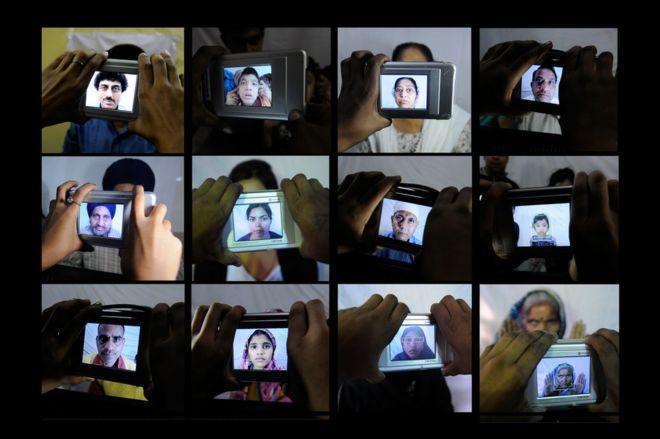
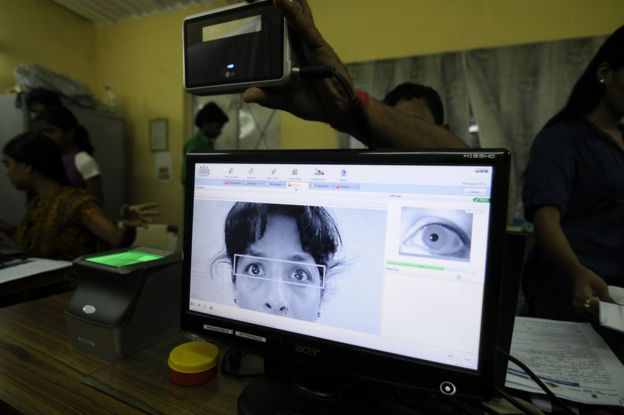
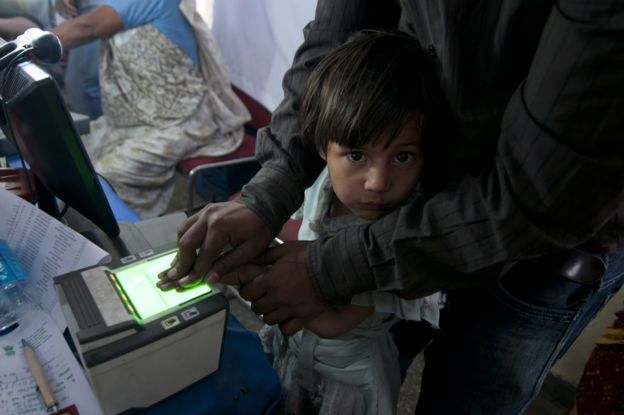
India's biometric database is the world's largest. Over the past eight years, the government has collected fingerprints and iris scans from more than a billionresidents - or nearly 90% of the population - and stored them in a high security data centre. In return, each person has been provided with a randomly generated, unique 12-digit identity number.
For a country of 1.2 billion people with only 65 million passport-holders and 200 million with driving licenses, the portable identity number is a boon to the millions who have long suffered for a lack of one.
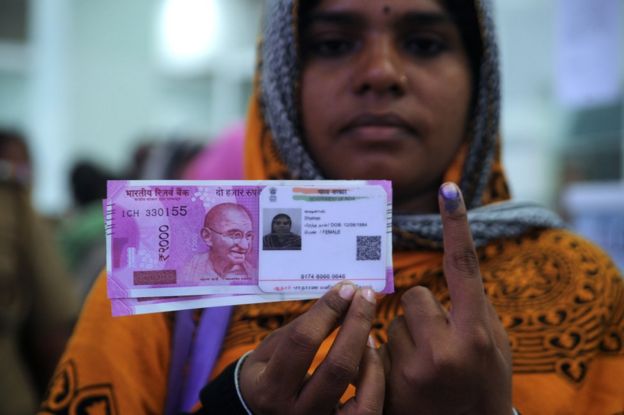
An Indian woman poses with new 2000 rupee notes, her Aadhaar ID card and a finger inked with indelible ink after exchanging withdrawn 500 and 1000 rupee banknotes at a bank in Chennai on November 17, 2016Image copyrightAFP
Image captionIndians will need the identity number to receive benefits from more than 500 welfare schemes
States have been using the number, also called Aadhaar (Foundation), to transfer government pensions, scholarships, wages for a landmark rural jobs-for-work scheme and benefits for cooking fuel to targeted recipients, and distribute cheap food to the poor.
Over the years, the number has taken a life of its own and begun exerting, what many say, is an overweening and stifling control over people's lives. For many like political scientist Pratap Bhanu Mehta, Aadhaar has transmuted from a "tool of citizen empowerment to a tool of state surveillance and citizen vulnerability".
People will soon need the number to receive benefits from more than 500 of India's 1,200-odd welfare schemes. Even banks and private firms have begun using it to authenticate consumers: a new telecom company snapped up 100 million subscribers in quick time recently by verifying the customer's identity through the number.

'Forcibly linked'

People are using the number to even get their marriages registered. The number, says Nikhil Pahwa, editor and publisher of Indian news site MediaNama, is "being forcibly linked to mobile numbers, bank accounts, tax filings, scholarships, pensions, rations, school admissions, health records and much much more, which thus puts more personal information at risk".
Some of the fears are not without basis.
The government has assured that the biometric data is "safe and secure in encrypted form", and anybody found guilty of leaking data can be jailed and fined.
But there have already been a number of leaks of details of students, pensioners and recipients of welfare benefits involving a dozen government websites. Even former Indian cricket captain MS Dhoni's personal information was mistakenly tweeted by an overzealous enrolment service provider.
AadhaarImage copyrightMANSI THAPLIYAL
Image captionThe fingerprints and iris scans are stored in high security data centres
Now a disturbing report by The Centre for Internet and Society claims that details of around 130-135 million Aadhaar numbers, and around 100 million bank numbers of pensioners and rural jobs-for-work beneficiaries have been leaked online by four key government schemes.
More than 230 million people nationwide are accessing welfare benefits using their numbers, and potentially, according to the report, "we could be looking at a data leak closer to that number". And linking the number to different databases - as the government is doing - is increasing the risk of data theft and surveillance.
The chief law officer believes that the outrage over the leaks is "much ado about nothing".
"Biometrics were not leaked, only Aadhaar numbers were leaked. It is nothing substantial. The idea is biometrics should not be leaked," Mukul Rohtagi told the Supreme Court on Tuesday.
The government itself has admitted that it has blacklisted or suspended some 34,000 service providers for helping create "fake" identification numbers or not following proper processes. Two years ago, a man was arrested for getting an identification number for his pet dog. The government itself has deactivated 8.5 million numbers for incorrect data, dodgy biometrics and duplication. Last month, crop loss compensation for more than 40,000 farmers was delayed because their Aadhaar numbers were "entered incorrectly by banks".

'Mass surveillance'

There are also concerns that the number can be used for profiling. Recently, authorities asked participants at a function in a restive university campus in southern India to provide their Aadhaar identity numbers. "This is not only a matter of privacy. The all pervasiveness of the Aadhaar number is a threat to freedom of expression, which is a constitutional right," Srinivas Kodali, who investigated the latest report on data leaks, told me.
Critics say the government is steaming ahead with making the number compulsory for a range of services, violating a Supreme Court order which said enrolment would be voluntary. "The main danger of the number," says economist Jean Dreze, "is that it opens the door to mass surveillance."
AadhaarImage copyrightMANSI THAPLIYAL
Image captionDetails of millions of Aadhaar number holders have been leaked
Nandan Nilekani, the technology tycoon who set up the programme popularly known by its acronym UIDAI, believes concerns about the safety of the biometric database are exaggerated.
He says the identity number has cut wastage, removed fakes, curbed corruption and made substantial savings for the government. He insists that the programme is completely encrypted and secure. "It's like you are creating a rule-based society," he told Financial Times recently, "it's the transition that is going on right now."

Abused

More than 60 countries around the world take biometric data from its people, says Mr Nilekani. But then there are nagging concerns worldwide about these databases being abused by hackers and state intelligence.
In 2016, personal details of some 50 million people in Turkey were reportedly leaked. (Turkey's population is estimated at 78 million.) In 2015, hackers stole more than five million fingerprints after breaching US government networks. In 2011, French experts discovered a hack involving the theft of millions of people's data in Israel.
Pratap Bhanu Mehta has written that the lack of a "clear transparent consent architecture, no transparent information architecture, no privacy architecture worth the name [India doesn't have a privacy law], and increasingly, no assurance about what exactly you do if the state decides to mess with your identity" could easily make Aadhaar a "tool of state suppression".
So a lot of lingering doubts remain. How pervasive should an identity number be? What about the individual freedom of citizens? How do you ensure the world's biggest biometric database is secure in a country with no privacy laws and a deficient criminal justice system?
In many ways, the debate about Aadhaar is also a debate about the future of India. As lawyer Shyam Divan argued forcefully in the top court, "people are reduced to vassals" when the state controls your body to this extent.