
By Anote Ajeluorou (Head, Politics)
12 June 2019 | 3:03 am
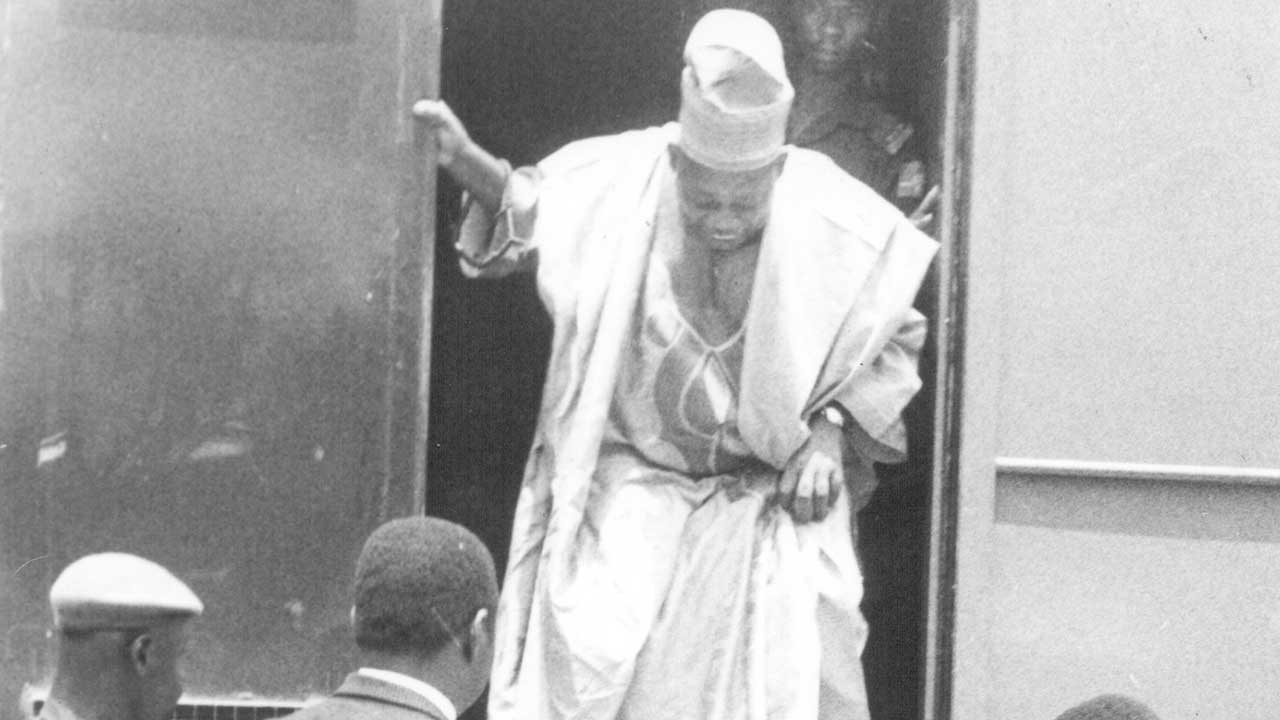 Heroes of the struggle
Chief Abraham Adesanya was among some of the few Nigerian pro-democracy campaigners who did not flee the country in spite of the personal danger to their lives. As deputy leader of NADECO, he stayed at home and fought against both Gen. Ibrahim Babangida and Gen. Sani Abacha on the annulment of June 12 even after his NADECO leader, Chief Anthony Enahoro, had been hounded abroad. He was uncompromising and became a thorn to the maximum dictators. A man of progressive political inclination, he had been active from the days of Action Group in the late 1950s and remained so until his death. He narrowly escaped death in the hands of Abacha’s death squad, which shot at him and his driver. He lived to a ripe, old age. He died at 85.
Heroes of the struggle
Chief Abraham Adesanya was among some of the few Nigerian pro-democracy campaigners who did not flee the country in spite of the personal danger to their lives. As deputy leader of NADECO, he stayed at home and fought against both Gen. Ibrahim Babangida and Gen. Sani Abacha on the annulment of June 12 even after his NADECO leader, Chief Anthony Enahoro, had been hounded abroad. He was uncompromising and became a thorn to the maximum dictators. A man of progressive political inclination, he had been active from the days of Action Group in the late 1950s and remained so until his death. He narrowly escaped death in the hands of Abacha’s death squad, which shot at him and his driver. He lived to a ripe, old age. He died at 85.
Prof. Omo Omoruyi who was Director-General, Centre for Democratic Studies (CDS), had the fortune to be friends to both Abiola and Babangida and often acted as go-between for the two. In fact, it was from him that Abiola got the encouragement to run for president when he wasn’t so sure if Babangida was really serious about relinquishing power or wanted to transform into a democratic president. Omoruyi actually fell out with Babangida for not honouring his word on June 12 and making Abiola president. It soured their relationship for a long time; he was privy to some of the internal wrangling within the military and among the northern establishment about power shift from the north to the south and the consequent denial that Abiola suffered. Omoruyi is believed to have developed the innovative Option A-4 adopted and Open Ballot system for the conduct of June 12 election, as CDS boss, but he is hardly credited for it.
Frank Ovie Kokori as secretary of the powerful oil workers’ union, Nigerian Union of Petroleum and Natural Gas (NUPENG), took on the military establishment and held it in the jugular. The union called out strikes that paralysed the country and put the military on edge. Kokori would later be imprisoned for long months for his activism. But he was undaunted about his personal travails as he forged on for the actualization of June 12.
Chief Gani Fawehimni did not suffer violent death like Kudirat and Rewane, but his death, which came much later, was diagnosed to be as a result of his long and intermittent incarcerations as a result of agitating for June 12 and the enthronement of democratic ideals in the country. A legal luminary and well-respected writer, and publisher, Fawehimni was first among equals both in the legal profession where he excelled and democratic activism when he gave Babangida and Abacha hard times to restore the rights of Nigerians and to respect their democratic wishes freely expressed through balloting. As many times he was in and out of prisons, so also was he in and out of the courts seeking one form of justice or the other for Nigerians whose rights had been breached by the state. Fawehimni was an icon of the struggle for the enthronement of democratic practice in the country and for which his consistent imprisonment would take a heavy toll on his health years later. He died on September 5, 2009.
Prof. Humphrey Nwosu was the National Electoral Commission (NEC) who conducted the watershed June 12 election. He took over from Prof. Eme Awa when the commission was still called Federal Electoral Commission (FEDECO) before it was renamed NEC. Nwosu resisted the courts in their flip-flop attempts to scuttle the exercise and courageously went ahead to conduct the election and had started reading out results before his boss, Babangida, ordered him to stop further announcements and consequently annulled the election.
But when he wrote a book, Laying the foundation for Nigeria’s democracy: my account of June 12, 1993 presidential election and its annulment, some 15 years later about what transpired on June 12, he absorbed Babangida of blame and generally failed to say exactly what really happened. Of course, his book was dismissed as obtuse and failing to give accurate account of June 12 annulment from his vintage point as the electoral umpire.
Others:The history of the struggle for June 12 to be made real while the winner of the historic election was alive had a robust assemblage of agitators. They played one role or the other both for the reversal of the annulment and subsequently the eventual enthronement of democracy. Rear Admiral Ndubuisi Kanu (rtd), Chief Ayo Adebanjo, Chief Ayo Opadokun, and former Lagos State governor, Bola Ahmed Tinubu were of the NADECO league, who campaigned vigorously for the realization of June 12. Tinubu was among those who had to go on exile for fear of being killed by Abacha’s rampaging death squad.
Nobel laureate Prof. Wole Soyinka also disguised and went on exile. One time local branch president of Academic Staff Union of Universities (ASUU), Prof. Festus Iyayi, lawyer, writer, and activist, Dr. Ogaga Ifowodo, Campaign for Democracy (CD) activist, Chima Ubani, writer and guerilla journalist, Mr. Odia Ofeimun, journalist and jailed for his work for democracy, Mr. Kunle Ajibade, lawyer, writer, and NADECO chieftain, Fred Agbeyegbe, medical doctor, activist, and Civil Liberties Organisation chieftain, Dr. Beko Ransome-Kuti, lawyer and activist, Chief Olisa Agbakoba, activist, Ayo Obe, Chief Adekunle Ajasin, Col. Tanko Umar, former governor of Kaduna State, Balarabe Musa, Lt.-Gen. Alani Akinrinade, two-time governor of Ekiti State, Dr. Kayode John Fayemi, former presidential candidate of Action for Democracy (AD) and chairman of Social Democratic Party (SDP), Chief Olu Falaye, and former president of Nigerian Labour Congress (NLC), Paschal Bafyau.
These actors were unarguably the men and women who kept the popular imagination alive about the June 12 saga, both during the heady days of the infamous annulment and long after when democracy had been restored. They have always insisted that Nigeria be returned to true federalism on which the country got her independence from Britain before military incursion into politics truncated the aspirations of the people for a truly popular democracy, not the sort unitarist stype instituted by the military as currently being practised, but genuine democracy that emanates from the people’s will on how they wish to be governed.
Martyrs of June 12Alhaja Kudirat Abiola as Abiola’s first wife became a martyr of the June 12 struggle. She was assassinated on June 4, 1996 on the streets of Lagos at Oregun. She was relentless both for the campaign for the release of her husband from prison and the actualization of June 12. But Abacha and his military goons could not stomach her activism. She became a thorn in their flesh as she espoused the ideal of democratic values and stood solidly behind her husband and the Nigerian people who voted for him. She was to pay the supreme price as she fell to the bullets of Abacha’s killers. The story of the struggle for June 12 cannot be written without her active, frontline role in it. Kudirat unarguably the heroine of June 12
Chief Alfred Rewane’s progressive politics as financier of democratic ideals came to an abrupt end on October 6, 1996 when he was murdered in his Ikeja, Lagos residence. He was chief financier of NADECO and pro-democracy meetings were regularly held in his house. His long-standing relationship with Chief Obafemi Awolowo established him in the direction of progressive politics even as he was a known businessman and industrialist. But it was in his politics and activism for the realization of June 12 that he would lose his life in gruesome manner.
ALSO, the unions, civil society organization and groups played defining roles for the popular agitation. In fact, without the unions the struggle would not have had so much momentum; it would have fizzled out if left alone to career politicians some of who, like Abiola’s running mate, Alhaji Babagana Kingibe, immediately switched camps and joined the unpopular government of Abacha in clear disregard of the mandate freely given to him and Abiola by the Nigerian people.
The Nigerian Bar Association (NBA), Nigerian Union of Journalists (NUJ), Petroleum and Natural Gas Senior Staff Association of Nigeria (PENGASSAN), Academic Staff Union of Universities (ASUU), led then by Dr. Asisi Asobie, Nigerian Labour Congress (NLC), Campaign for Democracy (CD), Civil Liberties Organization (CLO), and National Democratic Coalition (NADECO) were the arrowhead of the agitation for the realization of June 12.
Villains of June 12Alhaji Bashir Tofa was the Kano businessman who ran on National Republican Convention (NRC) party as opposition to Chief Moshood Kasimawo Olawale Abiola. But Tofa lost his home city to Abiola who was the accepted candidate of all Nigerians, as his popularity cut across ethnic and religious lines. In spite of calling to congratulate Abiola, he later worked closely with the military. His emergence was even controversial, as he was regarded as an unknown political quantity.
Chief Ebenezer Babatope is one of the Southwest leaders who betrayed the June 12 struggle. While it was rosy, he and others flocked round Abiola. But when Abacha shoved aside Shonekan and upturned the scale, Babatope was among those who legitimised his regime. He served as Minister of Transport and Aviation. Years later, Babatope still would see no wrong in his actions in betraying a kinsman of having his democratic right enforced. He claimed pro-democracy leaders, particularly of National Democratic Coalition (NADECO) prevailed upon Abiola not to accept Abacha’s planned bail offered him. Babatope, like others of his kind, would later form the kernel of PDP and become the biggest beneficiary of the democratic dispensation they helped Abacha stifle. He is still a member of PDP board of trustees.
Alhaji Lateef Jakande is another enemy of June 12. Like Babatope, he abandoned the struggle for June 12 and joined Abacha’s regime that hounded many into exile, hauled many into prisons and killed many for agitating for the actualization of June 12. A veteran journalist and former governor of Lagos State from 1979 till 1983 under Unity party of Nigeria (UPN) before Gen. Muhammadu Buhari struck in a coup, Jakande had earned a respectable name for himself as a progressive politician and left an indelible mark on the landscape of the state he presided over. But the June 12 saga dented his image, as he pandered to the undemocratic regime of a maximum dictator and served under him.
Brigadier-General Haliru Akilu was Director-General of National Intelligence Agency and Babangida’s shadow. Virtually all the underhand dealings of the Babangida era were attributed to him. He was involved in the plot that thwarted the June 12 election, as he also worked closely with ABN.
Chief Clement Akpamgbo was Attorney-General of the Federation and was instrumental to the annulment. He worked closely with Chief Arthur Nzeribe’s ABN that masterminded the court processes that were to scuttle the election. As Attorney-General, he had his brief to do everything possible for June 12 not to materialize. The courts were his ready playground and he used them to achieve Babangida’s ultimate aim.
Alhaji Babagana Kingibe is perhaps the biggest betrayer of June 12. As chairman of SDP, he was imposed on Abiola as running mate by the SDP governors at the time after he (Abiola) had initially settled for Alhaji Abubakar Atiku. Kingibe initially stood toe-to-toe with Abiola in the struggle for the actualization of June 12. But as the struggle intensified and alliances began to shift, Kingibe would later switch position and join Abacha, his Kanuri kinsman to uncut the struggle and join government as Minister of Internal Affairs. He served actively in the government that would detain Abiola for five years. His betrayal of his principal was total.
Chief Ernest Shonekan, a fellow Yoruba man like Abiola, would infamously agree to serve in the make-shift Interim National Government (ING) put in place by Babangida after he had been forced by unrelenting agitation to restore June 12 but failed to do so. In his haste to leave power, he left behind him a quasi-government that soon crumbled under Abacha, who stepped in and became the maximum dictator for another five years before death would ease him out of Nigeria’s political scene.
Shonekan’s government was weak from start, as it had no moral foundation to exist in the first place. When it fell to Abacha, no one missed it as it was rightly believed to be Babangida’s illegal and face-saving arrangement. Shonekan’s rating would plummet before Nigerians as a man who, like the biblical Esau, sold Nigerian’s democratic rights for a mess of porridge. His failing perhaps was that as an establishment man at United African Company (UAC), he felt it his duty to obey the powers-that-be and accept a role that would taint his sterling record at UAC.
Justice Bassey Ikpeme showed back then that the journey of Nigeria’s judiciary to the path of infamy started a long time ago. She showed herself a willing tool of the government which recruited her to do its bidding and thus set the country on fire. When government failed to use the courts to stop National Electoral Commission (NEC), headed by Prof. Henry Nwosu, to scuttle the election from holding, Ikpeme became the willing tool government used by hiding behind a shadowy Association for Better Nigeria (ABN), led by Chief Franmcis Arthur Nzeribe, to institute an ex parte motion to stop the conduct of the polls. In fact, there was a flurry of court actions at the time across the country – in Abuja, Benin City, Kaduna – to warrant the said confusion in the courts that Babangida would later cite as reason for annulling the election so as to “save the judiciary from ridicule,” he claimed.She ingloriously earned for herself the nickname of ‘Midnight Judge’ as her verdict came at 11pm! Other judges have since followed her path.
Justice Dahiru Saleh was Ikpeme’s right hand man in the judicial gymnastics that characterized the June 12. While Ikpeme’s court failed to get NEC to stop conducting the election, Saleh was waiting for Nwosu’s intransigence. He ruled in his court that the election was conducted in disobedience of a subsisting court order and that further announcement of the results be halted. Babangida merely stepped in to complete his pre-written script.
Chief Francis Arthur Nzeribe was in bed with the military perhaps because as an arms dealer, he felt his business would continue to boom under them. He did not want a return to democracy. He actually wanted Babangida to transit from military to civilian president. Babangida found him a willing ally for his devious plot to remain in power in perpetuity. Nzeribe formed ABN and had Abimbola Davis, a fellow Yoruba turncoat as Director of Operations of ABN to remove ethnic bias from the plot. The Uguta, Imo State-born businessman was a bundle of contradictions all through his active years. But his personality as a maverick got to its height during June 12 when his action steered the direction of ship of the Nigerian state down the precipice.
Only Davies recanted his June 12 actions after many years, but Nzeribe walked away from it all as if nothing happened, as he went down as enemy number one of Nigeria’s democracy. In spite of his odious action in annulling June 12 election, Nzeribe got elected into the Senate in 1999, but his people rejected his return bid in 2003. But since then he just faded from the national stage like a bad odour.
Olusegun Obasanjo, a former head of state, also played active role in the political tragedy that was the annulment of June 12. His infamous comment that Abiola was not the saviour that Nigerians were waiting for emboldened the military to trifle with the wishes of Nigerians on June 12. He could not stomach any other Yoruba man out-performing him at the national space. It was a reenactment of his 1979 fiasco when he ceded away Chief Obafemi Awolowo’s victory at the polls to a Alhaji Shehu Shagari.
So that when he became the biggest beneficiary of June 12 as the first democratically elected president in 1999 as a result of the agitations for June 12 and the institution of democracy, it was no surprise. He had been in cohort with those who annulled the election. It was the same military establishment that insisted he succeeded it.
Late Chief Tony Anineh became SDP’s party chairman after Kingibe became Abiola’s running mate. But like Kingibe, he would soon become lukewarm to the struggle for June 12 and turned a strategist for the military government that annulled his party’s victory. However, he would become one of the biggest beneficiaries of the agitation for the return to democratic rule as one of the pillars of Peoples Democratic Party (PDP) and fondly called ‘Mr. Fix It’ for the party. After the defeat of PDP in 2015, Anineh retired from active politics before he passed away.
Tom Ikimi was the chairman of National Republican Convention (NRC), one of the two political parties Babangida imposed on the political scene. He actively supported the annulment of the election. He would take up appointment in Abacha’s government as Minister of Foreign Affairs. A founding member of All Progressives Congress (APC), he would later dump the party last year for PDP after Adams Oshiomhole emerged the party’s chairman.
Gen. Sani Abacha was primed to inherit military leadership from Babangida, but the brazen manner of the annulled election and the violent resistance it engendered made for restrategising of tactics by the military hierarchy. When Babangida stepped aside, he should have retired Abacha, but he did not. That was a tactical error. So that when an Interim National Government (ING) was formed, Abacha saw his chance and promptly struck and seized power.
From announcing the overthrow of Alhaji Shehu Shagari in 1983 to seizing power on November 17, 1993, Abacha had been lurking in the shadows; he showed his hand when Nigeria was still reeling from the aberration that Shenokan’s ING generated. Pro-democracy and civil society organizations and groups were still up in arms against what the military had done and wanted the ING out. Abacha came and showed that even Babangida was a benevolent dictator; Abacha brought with him a crude form of dictatorship that annihilated many Nigerians. Those who escaped death in his hands were thrown into jail or simply went into exile. The country heaved a sigh of relief when he died on June 8, 2008.

