Monday, 13 August 2018

Letter from Africa: Heroes and villains of Nigeria's parliament siege


Around the BBC

  • 13 August 2018
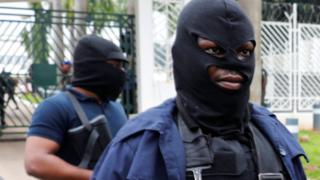
Masked men outside parliament in NigeriaImage copyrightREUTERS
In our series of letters from Africa, Nigerian writer and novelist Adaobi Tricia Nwaubani says scenes resembling a coup in her country have left many scratching their heads.
Nigerians still can't say for sure why armed, masked men held our country's parliament under siege last week. But the alarming incident had a most joyous ending.
They blocked all entrances to the building, denying lawmakers, civil servants and journalists access.
It turned out they were operatives of the state's spy agency, the Department of State Security (DSS), headed by Lawal Daura.
The other man at the centre of the drama is Senate President Bukola Saraki, who recently defected from the ruling APC party to the main opposition PDP.
Image captionThe anger boiled over as people challenged the armed men about what they were doing
He had called a parliamentary meeting of national assembly leaders - and it was this group that the armed men were blocking.
One theory is that it was a strong-arm tactic to make Mr Saraki resign so that the APC can appoint a ruling party senate president in his place.
The other theory is that it was all staged to make it appear as if it was officially sanctioned to make the government look bad.

'Invitation to anarchy'

Neither theory stands up to logical scrutiny, but you should never let anything surprise when it comes to the antics of Nigerian politics.
In April, a disgruntled MP allegedly organised for intruders to storm the Senate and steal its mace.
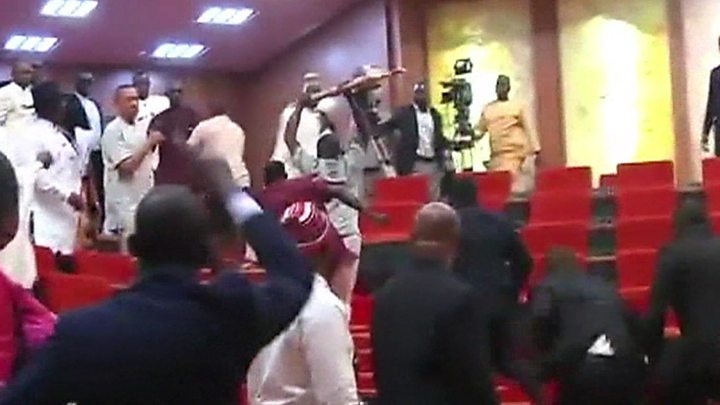
Media captionMoment intruders steal ceremonial mace from Nigeria's Senate
Decisions in the upper chamber cannot be approved without the mace - a large ornamental staff that represents the legislature's authority.
But when news spread of the events last week, including videos of angry lawmakers in confrontation with the armed state operatives, even Nigerians expressed their condemnation.
President Muhammadu Buhari was away in the UK on vacation, leaving his deputy Yemi Osinbajo in charge.

Adaobi Tricia Nwaubani
Adaobi Tricia Nwaubani:
"Nothing about Yemi Osinbajo excites the usual comedy that Nigerians have come to expect from our leaders"
"Nigeria is a democracy not a military dictatorship," said Atiku Abubakar, a former vice-president and PDP presidential hopeful.
"The acting president, being himself a professor of law, ought to know that setting such a precedent is an invitation to anarchy."
And indeed it was Mr Osinbajo who became the hero of the day.
Not only is Mr Osinbajo a professor of law and a former commissioner for justice, he is arguably one of the most distinguished leaders to have graced the Nigerian seat of power in the past few decades.
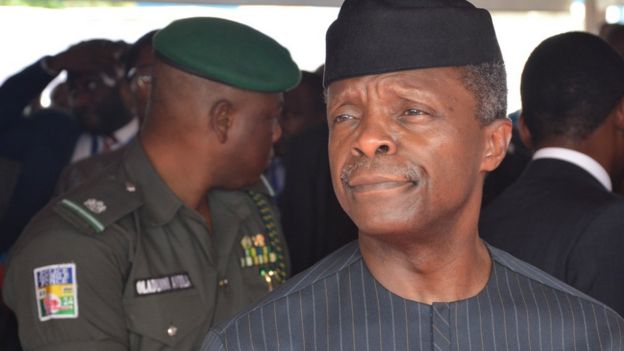
Yemi Osinbajo
Image captionVice-President Yemi Osinbajo has emerged as one of the heroes of the siege
For starters, nothing about him excites the usual comedy that Nigerians have come to expect from our leaders.
His educational qualifications are without suspicion. His foot does not get jammed in his mouth each time he speaks. He has no known girlfriends flaunting flashy cars and shady contracts around the capital city, Abuja. He has no known cadavers stinking in his cupboard.
Mr Osinbajo has even been heard to apologise after arriving late at events. The typical Nigerian public office holder's self-importance can usually be measured by how long they can keep people waiting.
And the vice-president did not disappoint. While the siege was ongoing, he released a statement denouncing it as "condemnable and completely unacceptable".
Then he announced the immediate dismissal of Mr Daura - and the masked men were recalled to their lair.

You may also like:

Again, Nigerians can't say for sure if Mr Daura was simply a scapegoat for a failed coup, or if he was indeed acting without presidential authority, motivated by his loyalty to Mr Buhari, his kinsman from the village of Daura in Katsina state, north-western Nigeria.
But, I promised you a happy ending, didn't I?

Midnight arrests

Many Nigerians feel that if it took the siege on parliament to be finally rid of the spy chief - then hurray.
In 2015, the sexagenarian was exhumed from retirement and appointed to head the DSS.
In the past three years of Mr Daura's leadership, the agency has been characterised by midnight arrests on those suspected of corruption, disdain for court orders, detention of a journalist without trial, and the harassing of lawmakers at a federal and state level.
Many Nigerians feared that as he came from Mr Buhari's hometown it had made him untouchable.
Image captionMr Osinbajo described the siege as "condemnable and completely unacceptable"
We had resigned ourselves to the ongoing nightmare.
But, as the saying goes: he whom the gods wish to destroy, they first make mad.
The madness that Mr Daura seemed to display by launching the siege has now led to his ignominious fall.
On the acting president's orders, Mr Daura was arrested and although released a few days later, his passport was seized.
Mr Osinbajo described his antics as "a gross violation of constitutional order, rule of law and all accepted notions of law and order". Mr Daura has yet to put his side of events.
But many Nigerians are now hoping that he will have that opportunity in court. What an even more joyous ending that would be - and one that follows the rule of law.

More Letters from Africa

Follow us on Twitter @BBCAfrica, on Facebook at BBC Africa or on Instagram at bbcafrica

Related Topics

More on this story

Thursday, 2 August 2018

Obasanjo, Tinubu and the sour taste of an old romance


It is an irony that the two leading Yoruba personages in pubic space today may not share similar view of the future. Chief Olusegun Obasanjo, the energetic retired President of the Republic has stated his objective clearly: he does not want President Muhammadu Buhari to run for a second term because of what he considers Buhari’s disastrous record in managing the nation’s security. Asiwaju Bola Ahmed Tinubu was the political genius who created the All Progressives Congress, APC, from an amalgam of disparate groups. He is an ally of Buhari whom he helped installed in power in 2015. Whether Buhari remains his ally is another matter.
Obasanjo was brought up to distrust politicians. In contrast, Tinubu grew into politics under the wings of the formidable Alhaja Abibatu Mogaji, the legendary amazon who as the leader of Lagos market men and women, was a deciding factor in Lagos politics for several decades. The 2019 elections would be a litmus test for both Tinubu and Obasanjo and both have shown capacity for national relevance. Both of them fought the last general elections in 2015 as strong allies of President Muhammadu Buhari. 2019 may be decidedly different.
As a young subaltern of the new Nigerian Army, Obasanjo was drafted into the Congo, where the politicians, Patrice Lumumba, the Prime Minister and Josef Kasavubu, the President, disagreed on how to govern the newly independent country. One day Obasanjo was captured by rebel soldiers. He was miraculously escaped execution. He returned to Nigeria later only to meet a country messed up by politicians until the soldiers, led by his bosom friend, Major Chukwuma Kaduna Nzeogwu, ended the life of the First Republic during the first coup on January 15, 1966. Nzeogwu had opened the Pandora box.
Worse days were to come. The soldiers could not manage what they inherited and like the Congo, Nigeria was plunged into a civil war and Obasanjo again found himself on the war front as the General Officer Commanding the Third Marine Commando Division. One day he drove into an ambush, was wounded and carried the scar till today. When his friend and boss, General Murtala Muhammed was killed during the abortive coup of February 13, 1976, Obasanjo became Nigerian ruler “against my personal wish and desire.”
He did the uncommon when he handed over power to elected President Shehu Aliyu Shagari on October 1, 1979, leading the military back into the barracks. One day he attended the Council of States meeting in Doddan Barracks which the politicians have renamed State House Ribadu Road Ikoyi. Shagari tabled the government’s effort to tackle wide spread hunger in the land by setting up a Presidential Task Force for Rice Importation. Obasanjo flared up, calling Shagari a shameless President. “You are not ashamed to eat rice grown by farmers of other countries!” he growled at the President. “You cannot set up a Presidential Task Force to grow rice!”
It was to be the beginning of Obasanjo clash with his successors.The new path was to ultimately lead him into prison and ultimately back to power when he returned as an elected President 20 years after he retired as military ruler. After eight tumultuous years, he installed his successor, President Umar Musa Yar’Adua who died in office and was succeeded by his Vice-President, Goodluck Ebele Jonathan. Obasanjo clashed with Jonathan, and helped to install his former officer, Buhari, in his stead. Now he has taken on Buhari and that is pitting him against Tinubu who in their brief romance, once described Obasanjo as the national “navigator” of the impossible alliance that Tinubu cobbled together to bring Buhari to power.
Though Tinubu has been restrained in criticizing Obasanjo, there is no doubt that the romance is over. Tinubu’s odyssey has taken a different path from that of Obasanjo. He came into national prominence when became one of the leading lights of the Social Democratic Party, SDP, during the closing days of General Ibrahim Babangida ultimately futile transition programme. He was one of the youngest members elected into the Senate and when the June 12 crisis exploded on the national stage, he was one of the most trusted supporters of Chief Moshood Abiola. In the wake of the crisis, he fled into exile becoming one of the leaders and financiers of the external wing of the opposition National Democratic Coalition, NADECO.
The struggle against the dictator, General Sani Abacha, who had imprisoned Obasanjo and many other opposition figures, put him and Tinubu on the same side. By the dawn of the new republic in 1999, Obasanjo was President in Abuja and Tinubu governor in Lagos. They were to clash several times, including over Tinubu’s attempt to create new local government areas in Lagos. Obasanjo was of the Peoples Democratic Party, PDP, while Tinubu was the Alliance for Democracy, AD, governor of Lagos State which in alliance with the All Peoples Party, APP, had fielded Chief Olu Falae, the only opponent of Obasanjo at the 1999 presidential election. Both Tinubu and Obasanjo left power at the same time in 2007 but have remained in politics since then. The 2015 general elections was the first time both of them would be playing on the same team. They won. Now the brief flirtation seems to be over.
What is at stake may be more than the job of Buhari. Since Obasanjo left power, there have been a stirring in the land which has now grown into a loud chorus that Nigeria needs to restructure its polity. In the beginning, many of the leading lights of the APC, especially the old ACN faction headed by Tinubu, had claimed ownership of this movement for restructuring. Its members spearheaded the publication of The Yoruba Agenda which called for the grouping of the Federation into more viable regions with the states of Oyo, Osun, Ekiti, Ondo, Ogun and Lagos constituting one region. When the Jonathan Constitutional Conference recommended the same panacea, it was felt that the politicians were reaching something close to a consensus on the matter. However, since Buhari got to power, there seem to be distaste for new constitutional arrangement among members of the Buhari court.
Neither Obasanjo nor Tinubu has made categorical statement on the kind of future constitutional arrangement they envisioned for Nigeria. However, Obasanjo has been flirting more with Buhari’s opponents who are now claiming ownership of the call for constitutional reforms and restructuring. In the emerging coalition are also disparate forces and seasoned carpetbaggers who seem to be interested more in the juicy fruits of power. The drama is taking new dimensions including the violent participation of shadowy Fulani herdsmen and the terrorist group, Boko Haram. Despite Buhari’s claim to spending billion of naira on security, the army of evil remains active in the Nigerian commonwealth. In the league are the likes of kidnappers, cultists, robbers, drug dealers and peddlers and they appeared emboldened because past perpetrators or seldom caught and rarely punished.
In the struggle to keep Buhari in the saddle or topple him through the ballot box the Buhari coalition would have more than Obasanjo and his team to deal with. The failed romance of Obasanjo and Tinubu is an indication of the slippery terrain of Nigerian politics. More so, it advertises the inability of our President to keep his friends and presides over a far-flung political empire. This is a fundamental flaw on the part of Buhari. A President who cannot keep his friends may hardly be expected to have the wherewithal to win over his foes.

Monday, 23 July 2018

Banks in excess loan deduction saga

The Guardian


A growing number of Nigerians are now afraid to borrow money from the banks, not just for their inability to pay back, but that they would pay twice what they suppose to pay at the end of the transactions.
The development that portends eroding confidence in banking relationship, going by the level of complaints and alleged excess deductions on loan facility, may set back the level of progress reached in the financial inclusion drive.
Currently, a major bank is in full fledged court battle over alleged excess deductions running into billions of naira, while another one with international presence may soon emerge the next “bubble burst” in what may appear as a series of saga that would dominate the banking industry.
The new discovery is alleged to be excess deductions worth more than half a billion, which the lender has admitted part of the total.

The excess deduction means that apart from the agreed terms, changes in inflation level and any change in the Monetary Policy Rate during the period of the loan, banks deduct more money from the account of borrowers than what is due to them.
A former banker that worked in the control units of several banks with nearly two decades’ experience told The Guardian that this “over-deduction” or “excess deduction” on loan facility is subtle and normal thing done by every bank, but being discovered by few customers recently.
“The truth is that only few of the borrowers crosscheck their overall transactions, whether periodically or at the loan term. Some banks, if not all, even make provisions to suppress any protest, depending on the value involved. Some settle it quietly.
“It is worse for big ticket deals, I mean, those borrowing in billions. These ones, their interest deductions run into millions monthly. And that is when these excess deductions happen more. It is not a system malfunction, but a deliberate way of making money for banks by those in charge, as they are more of ‘traders’ for these financial institutions.
“Many customers also do not even know their rights and processes. But some that know, feel intimidated, considering the assessed financial strength of banks to suppress them at any level.
“Besides, some grossly overlooks the infraction on the conclusion that it will take more than the value of the money to reclaim it. But now that the secret has been exposed, very soon, more people or companies will be contesting their banking transactions.
What the rule says
According to the revised guideline to Banks And Other Financial Institutions In Nigeria 2017, provides a basis for the application of charges on various products and services offered by banks and Other Financial Institutions (OFIs) in Nigeria to their customers. Where a charge is stipulated as “negotiable”, banks and OFIs are required to draw the attention of customers to their rights to negotiate and the two parties are required to mutually agree on the applicable interest and/or charge via a verifiable means. This is an obvious missing links in ban-customer relationship. They are not always fast about drawing the attention of customers to their rights to negotiate.
Section 2.1 of the guide said that local currency loans are negotiable, but “the rate should anchor MPR, reflecting the risk-based pricing model. Also, when the bank intends to introduce a new rate different from the agreed rate, the bank should notify the customer of the new rate at least 10 business days in advance of the application of the new rate.”
It is obvious that banks have severally breached this law, as majority of bank customers say they did not received notice before changes in their terms of loans.
Section 3.2.4 (g) of the CBN Monetary Policy No 39, provides that “banks shall refund identified excess charges, non-payment or under-payment of interest on deposits, unauthorised debits, along with interest.”
Also, in line with CBN Monetary, Credit, Foreign Trade and Exchange Guidelines, complaints relating to excess charges and loans shall be treated within 30 days as provided in the circular number FDR/DIR/CIR/GEN/009 of July 2, 2014. These provisions are variously violated by banks.
What the customers say
Onuama Ibe, a customer of one of the top five banks, said any mention of loan deal is now irritating to him, just as he recounted his ordeal and the struggle he made to end a loan facility due to unclear deductions.
For him, banks are taking advantage of the low knowledge-base of their customers to enrich themselves, saying one can only contest what one is aware of, adding that he never considered the deductions at a point, but seeing the end of the relationship once for all time.
Citing the experience of a major transport company that contested and got a reversal of such excess deductions worth millions, which the bank hurriedly obliged to avoid public knowledge, he said other transporters then used it as a model in negotiating loans with bank subsequently.
“I cannot go to bank again for any sort of borrowing. You can only understand what they are up to once you enter into the deal. It may start good, but sooner than later, things would change.
“Beside the case of excess deductions on loans, what about the money that is deposited, which they deplete severally for services that you did not ask for. At Christmas, Easter, Sallah, birthday and national holidays, among others, they send you goodwill messages and charge you, even with Value Added Tax,” Ibe bared his fangs.
A Nurse, who identified herself as Mrs. Ajala, said she hurriedly borrowed money from the cooperative society to repay the loan she collected from one of the top five banks, when the monthly got out of hand, noting that she could not afford to wait and scrutinize the bank’s withdrawals, citing costs, time wasting and more bills from the lender.
For Chuma Uko, beside banks’ regular illegal charges that are now in multiples, they debit you variously when you enter into loans and they do it like “nothing will happen.”
A transporter, Mr. Olayinka, said that if you enter into loan deal with a bank, that is when you will know that you have mortgaged yourself, not just the property to them. “What will remain for you is just to commit suicide. It is a ‘no go area’”, he added.
What the bankers say
In an encounter with the Director of Banking and Payments System of the Central Bank of Nigeria (CBN), ‘Dipo Fatokun, he said such development is something that should not be heard about in the industry, assuring that the regulator does not treat it with “kids glove.”
However, he said that such complaints are treated on merit, not just hearsay, advising that customers with such issues would need to sort it out with the commercial bank and when that fails, it must reported to the apex bank’s department for consumer protection.
According to him, it is on record that complaints of similar nature have been reported and illegal withdrawals worth billions of naira have also been reversed.
He also reiterated that there are always sanctions for erring institutions, depending on the level and manner of the infractions.
But in a random visit by The Guardian to 22 Business Managers of 15 different banks from Festac Town, Ago Palace Way to Okota areas in Lagos, only two, who would not want their names in print, explained their experiences and the level of customer complaints on the matter.
Both managers admitted receiving such complaints from few branch customers who have loan facilities, but differed in the causes of the deductions, while one dismissed entirely the realities of such in the bank.
The Business Manager of one of the top five banks said the complaints do not reflect realities, as loans and repayments are programmed, saying that while it may be possible in other banks, it is not obtainable in their organisation.
“I don’t know how others do their own. I only know that economic variables change and that reflect on repayment schedules. I also know that repayments can go up, but not necessarily possible to go down. Maybe, the differences they get from these economic variables make up their calculations.
“It is true that the level of knowledge in banking transactions is low and not many can dig deep to solve the intricacies involved in these calculations. But as a trusted partner, we have the duty to do what is right,” the banker said.
The other Business Manager from a mid-tier bank said that loans have direct link to the head offices not minding the branch where they are booked and complaints of excess deductions are always calibrated to the head office.
“Sometimes, there might be changes that will cause a significant charge, which may be interpreted as excess deductions. Well, I do not dismiss entirely the occurrence of such issue, but the reason is what I do not know,” the banker said.
What banks’ balance sheet says
The 2017 financial year was marked by challenges for all corporate organizations, as the recession effects bite harder. Banks, alreading reeling under difficulties, had more to grapple with, especially as non-performing loans’ status remain unbending, while credit to private sector becomes daring.
Surprisingly, 13 commercial banks posted a more than N2trillion net interest income, though majorly from the fixed income securities. This was an increase of about 11 per cent over the 2016 record. But private sector lending, now being subjected to questionings by the rising complaints of excess deductions, may have contributed too to the pool.
